Commentary

A Riskier World May Call for More Equities, Not Less.

The standard hedge is working less reliably just as shocks grow more frequent.

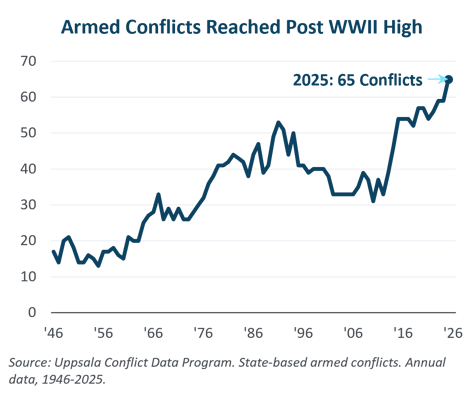
Armed Conflict Chart
Macroeconomic shocks appear to be arriving more often, highlighted by 65 armed conflicts involving a state in 2025 – the highest level since World War II. Layer on toxic trade politics, rising government debt, and more frequent extreme-weather events, and the macro backdrop is one of recurring disruption. The traditional response has been to reduce equity exposure in favor of bonds, but that conclusion assumes the historical relationship between stocks and bonds still holds.

For much of the past half century, U.S. government bonds effectively hedged equity weakness because most shocks were demand-driven, resulting in slower growth and falling rates. As yields declined, bond prices rose, offsetting equity losses during periods of stress. That negative correlation became a foundational assumption behind the traditional balanced portfolio.

Recent shocks have increasingly come from the supply side. Conflict, tariffs, and fiscal expansion can slow growth while pushing inflation and rates higher, weakening the case for bonds as a reliable offset. The second chart illustrates the shift: in earlier decades, Treasuries (the dark blue line) rallied sharply as equities fell, at times compounding more than 50% over the drawdown. In several of the most recent episodes, that contribution has been far smaller, and occasionally negative.
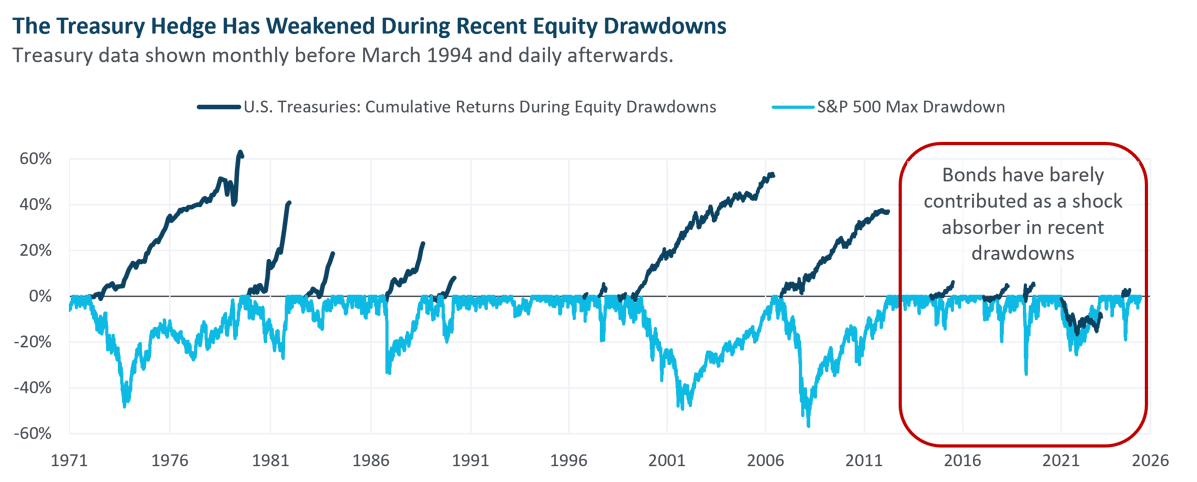
Treasuries During Drawdowns Chart 4This has led some long-term institutional investors to revisit their frameworks. In a Wall Street Journal article, Raphael Arndt, chief executive of Australia's Future Fund, argued that a structurally more volatile world warrants a higher equity exposure. If inflationary shocks erode the defensive value of bonds, investors may instead need to rely more on the long-term earnings growth of equities, even if it comes with a bumpier path

In an environment where shocks are more frequent and traditional portfolio relationships less dependable, we believe owning high-quality businesses with durable competitive advantages and the capacity to compound value through changing conditions remains a solid foundation for long-term investors.



Sources: Shawn Davies, Therése Pettersson, Magnus Öberg, Organized violence 1989–2025, and violent political protests, Journal of Peace Research, 2026. https://doi.org/10.1093/jopres/xjag046. Gleditsch, Nils Petter, Peter Wallensteen, Mikael Eriksson, Margareta Sollenberg, and Håvard Strand (2002) Armed Conflict 1946-2001: A New Dataset. Journal of Peace Research 39(5). UCDP is part of and funded by DEMSCORE, national research infrastructure grant 2021-00162 from the Swedish Research Council. Mackintosh, James. "How to Invest When the Global Crises Never Stop." The Wall Street Journal, 11 July 2026, www.wsj.com/finance/investing/how-to-invest-when-the-global-crises-never-stop-3c8cc542.

Please see Advisory Research’s Form ADV Part 2A, which is available upon request, for more information. Advisory Research is providing this material for informational purposes only. The information provided is not intended to recommend any company or investment described herein, and is not an offer or sale of any security or investment product or investment advice. Before making any investment decision, you should seek expert, professional advice and obtain information regarding the legal, fiscal, regulatory and foreign currency requirements for any investment according to the laws of your home country or place of residence.
 
Certain information contained herein constitutes forward looking statements, projections and statements of opinion (including statements of financial market trends). Such information can typically be identified by the use of terminology such as “may”, “will”, “should”, “expect”, “anticipate”, “project”, “estimate”, “intend”, “continue” or “believe” or comparable terminology. All projections, opinions and forward looking statements are based on information available to Advisory Research as of the date of this presentation, and Advisory Research’s current views and opinions, all of which are subject to change without notice. Due to various risks and uncertainties, actual events or results may differ materially from those reflected or contemplated in forward looking statements. Additionally, information and views presented herein may be drawn from third-party or public sources which are believed, but not guaranteed, to be reliable and which have not been verified for accuracy or completeness.
 
Advisory Research’s strategies are actively managed and not intended to replicate the performance of any cited index: the performance and volatility of Advisory Research’s investment strategies may differ materially from the performance and volatility of a cited index, and their holdings will differ significantly from the securities that comprise the index. You cannot invest directly in an index, which does not take into account trading commissions and costs.
 
The S&P 500® is widely regarded as the best single gauge of large-cap U.S. equities and serves as the foundation for a wide range of investment products. The index includes 500 leading companies and captures approximately 80% coverage of available market capitalization. The Bloomberg U.S. Treasury Index measures U.S. dollar-denominated, fixed-rate, nominal debt issued by the U.S. Treasury.
 
Advisory Research is an investment adviser in Chicago, IL. Advisory Research is registered with the Securities and Exchange Commission (SEC). Registration of an investment adviser does not imply any specific level of skill or training and does not constitute an endorsement of the firm by the Commission. Advisory Research only transacts business in states in which it is properly registered or is excluded or exempted from registration. A copy of Advisory Research’s current written disclosure brochure filed with the SEC which discusses among other things, Advisory Research’s business practices, services and fees, is available through the SEC’s website at: www.adviserinfo.sec.gov