We Interrupt This War with a Bubble
The last 12 months might be the best example of how investors constantly run from one side of the ship to the other. We ping ponged from AI bubble to high inflation to surprise war and back to the AI bubble in four quarterly narratives. Do investors even remember the war panic in March now?
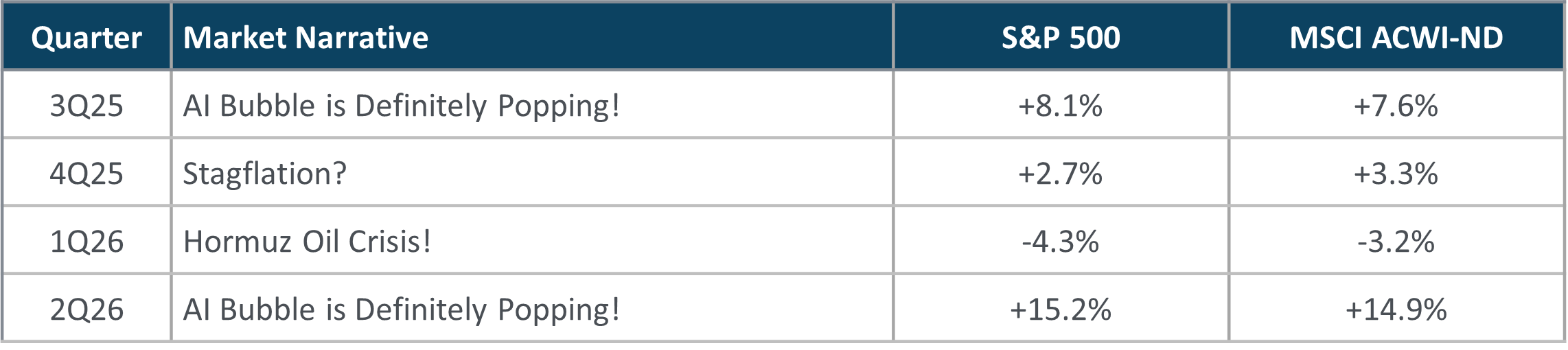
In our last quarterly letter, we expected a diplomatic solution in the Strait of Hormuz and that equities should remain resilient as moderate, controlled inflation supported earnings growth. So far so good.[1]
[1] Trivial Pursuit Fact: In Q2 2026, both the S&P 500 and MSCI ACWI (net dividend) recorded their best quarter since the post-pandemic rebound in Q2 2020. Source: eVestment. Past performance is no guarantee of future results. An index is unmanaged and unavailable for direct investment.
The Prediction Bubble
While financial bubbles are notoriously difficult to identify before they burst, bubble-like behavior is easy to spot: trillion-dollar IPOs, circular AI financing deals, and multibillion-dollar private market valuations for pre-revenue and pre-product companies. Yet, speculation remains a feature, not a bug, of free market growth. Such speculation—like SPACs, meme stocks, and various crypto cycles—collapse without triggering systemic economic crises. It seems like the only true bubble in today's market is the obsession with predicting one.
Numb to Prices?
Our definition of a bubble is when investors become numb to prices. We do not believe we are there today, and we might never be. In aggregate, the markets seem to be fairly pricing equities for their potential range of outcomes. We, like you, scratch our heads on certain stocks but we are also humble enough to understand that there is wisdom in the crowds. Valuations are elevated but remain tethered to reality (unlike during the late 1990s tech bubble). This is an important distinction.
Breadth, Not Bubble
Skeptics have called the top on AI twice in the last four quarters, and twice they've been wrong. The evidence argues for broadening, not bursting: a broad basket of AI-related stocks is up 40–80% year-to-date even as the Magnificent 7 has declined — earnings, not multiple expansion, are doing the work. Wide return dispersion within the AI complex, despite strong forward EPS growth across the group, suggests investors are discriminating between winners and pretenders rather than chasing a theme indiscriminately.
Valuation tells the same story. AI names trade at materially higher earnings multiples than the rest of the market but adjust for growth and AI's PEG ratio is actually the lower of the two — expensive on price, reasonable on growth.
AI is the Magic Pixie Dust
We are bullish on AI to transform businesses. AI is emerging as the defining general-purpose technology of our era, joining the ranks of the steam engine, electricity, and computing. Like those predecessors, it improves over time, is being adopted across virtually every corner of the economy and serves as a platform for entirely new categories of innovation.
At its core, AI has the capacity to lower the transaction costs of acquiring and applying knowledge, letting people and organizations solve problems faster than any prior tool allowed. That shows up as productivity — automating routine tasks, augmenting complex ones, and compounding gains across industries. It won't replace whole jobs so much as specific tasks within them: coding, customer service, supply chain functions, and communication are all ripe for disruption. That means real job losses in certain functions, but also new roles we can't yet foresee. History shows productivity is the magic pixie dust behind great economies — it fuels booms, keeps a lid on inflation, and lifts the fortunes of workers and business owners alike.
What We're Actually Watching in AI
Beneath the bubble debate, we think the more useful question is where the value creation shifts next. So far, “picks and shovels” providers—chipmakers like NVIDIA selling into the hyperscalers and model companies—have captured the bulk of AI-driven earnings growth. That’s been one of the easiest trades in the market, but it won't last forever.
We're closely watching two divergences: consumer AI vs. enterprise AI, and the shift from training-focused infrastructure to inference-focused infrastructure. The two have very different monetization models — enterprises pay for productivity (thus the SaaS market), while consumers prefer to be entertained, which calls for a different revenue model (insert ad here). The transition from training LLMs to real-world applications will also shift the mix of semiconductor chip architectures and, ultimately, create different winners.
The 2nd Half 2026 Look Ahead: “Wait, What?! How Many Hikes?”
While the “chattering class” engages in AI navel gazing, a more durable risk is taking its place: inflation. U.S. CPI has reaccelerated toward roughly 4%, amplified by the Iran war's lingering energy price impact layering onto already-building, stickier upstream pressures. The market has repriced accordingly, pivoting from expecting five cuts in 2026 (as recently as September 2025) to one-to-two hikes now being priced for this year.
We think even that repricing understates the risk. One could argue that the market remains too dovish given sticky and rising inflation in core services other than housing, aka “supercore” inflation. Layer on top of that AI's near-term buildout phase looks inflationary, not deflationary, as capex-driven demand and supply bottlenecks dominate before any efficiency gains materialize. The “AI will keep a lid on inflation” thesis we and others leaned on may prove premature, at least in this buildout phase. The reacceleration in the labor market is the key swing factor pushing rates higher with the potential for outright tightening extending into 2027 as the labor market tightens further.
Objectivity, Conviction, Humility
Our biggest lesson learned over nearly 20 years of managing money is to always fade the headlines and stick to our investment process. We remained focused on our disciplined process – objectivity and breadth, cash flows over earnings, accretive over destructive capital deployment – to build high conviction portfolios.
Disclosures:
Past performance does not guarantee future results. Investing in securities involves risk, including the possibility of the loss of principal.
Please see Advisory Research’s Form ADV Part 2A, which is available upon request, for more information.
Certain information contained herein constitutes forward looking statements, projections and statements of opinion (including statements of financial market trends). Such information can typically be identified by the use of terminology such as “may”, “will”, “should”, “expect”, “anticipate”, “project”, “estimate”, “intend”, “continue” or “believe” or comparable terminology. All projections, opinions and forward-looking statements are based on information available to Advisory Research as of the date of this presentation, and Advisory Research’s current views and opinions, all of which are subject to change without notice. Due to various risks and uncertainties, actual events or results may differ materially from those reflected or contemplated in forward looking statements. Additionally, information and views presented herein may be drawn from third-party or public sources which are believed, but not guaranteed, to be reliable and which have not been verified for accuracy or completeness.
Advisory Research is providing this material for informational purposes only. The information provided is not intended to recommend any company or investment described herein and is not an offer or sale of any security or investment product or investment advice. Before making any investment decision, you should seek expert, professional advice and obtain information regarding the legal, fiscal, regulatory, and foreign currency requirements for any investment according to the laws of your home country or place of residence.
The S&P 500® Index is designed to measure the performance of the large-cap segment of the US equity market. It is float-adjusted market capitalization weighted. The MSCI ACWI (All Country World Index) tracks the stock performance of over 2,400 large and mid-cap companies across 23 developed and 24 emerging markets, covering approximately 85% of the global investable stock market.
Advisory Research’s strategies are actively managed and not intended to replicate the performance of any cited index: the performance and volatility of Advisory Research’s investment strategies may differ materially from the performance and volatility of a cited index, and their holdings will differ significantly from the securities that comprise the index. You cannot invest directly in an index, which does not take into account trading commissions and costs.
Advisory Research is an investment adviser in Chicago, IL. Advisory Research is registered with the Securities and Exchange Commission (SEC). Registration of an investment adviser does not imply any specific level of skill or training and does not constitute an endorsement of the firm by the Commission. Advisory Research only transacts business in states in which it is properly registered or is excluded or exempted from registration. A copy of Advisory Research’s current written disclosure brochure filed with the SEC which discusses among other things, Advisory Research’s business practices, services and fees, is available through the SEC’s website at: www.adviserinfo.sec.gov.

.jpg?width=1000&height=1000&name=Swaim%20(website).jpg)
.jpg?width=1000&height=1000&name=Harvey%20(website).jpg)
.jpg?width=1000&height=1000&name=Steffanus%20(Website).jpg)
.jpg?width=1000&height=1000&name=M.%20Valentinas%20(website).jpg)
-min.jpg?width=394&height=394&name=Zessar%20(website)-min.jpg)
-1.jpeg?width=502&height=502&name=Florida%20(website)-1.jpeg)
.jpg?width=1000&height=1000&name=Lamb%20(website).jpg)
.jpg?width=1000&height=1000&name=Prassas%20(website).jpg)
.jpg?width=1000&height=1000&name=Crawshaw%20(website).jpg)
.jpg?width=1000&height=1000&name=Clarke%20(website).jpg)
.jpg?width=1000&height=1000&name=Cialdella%20(website).jpg)

.jpg?width=1000&height=1000&name=Harmon%20(website).jpg)
.jpg?width=1000&height=1000&name=Tracy%20(Website).jpg)