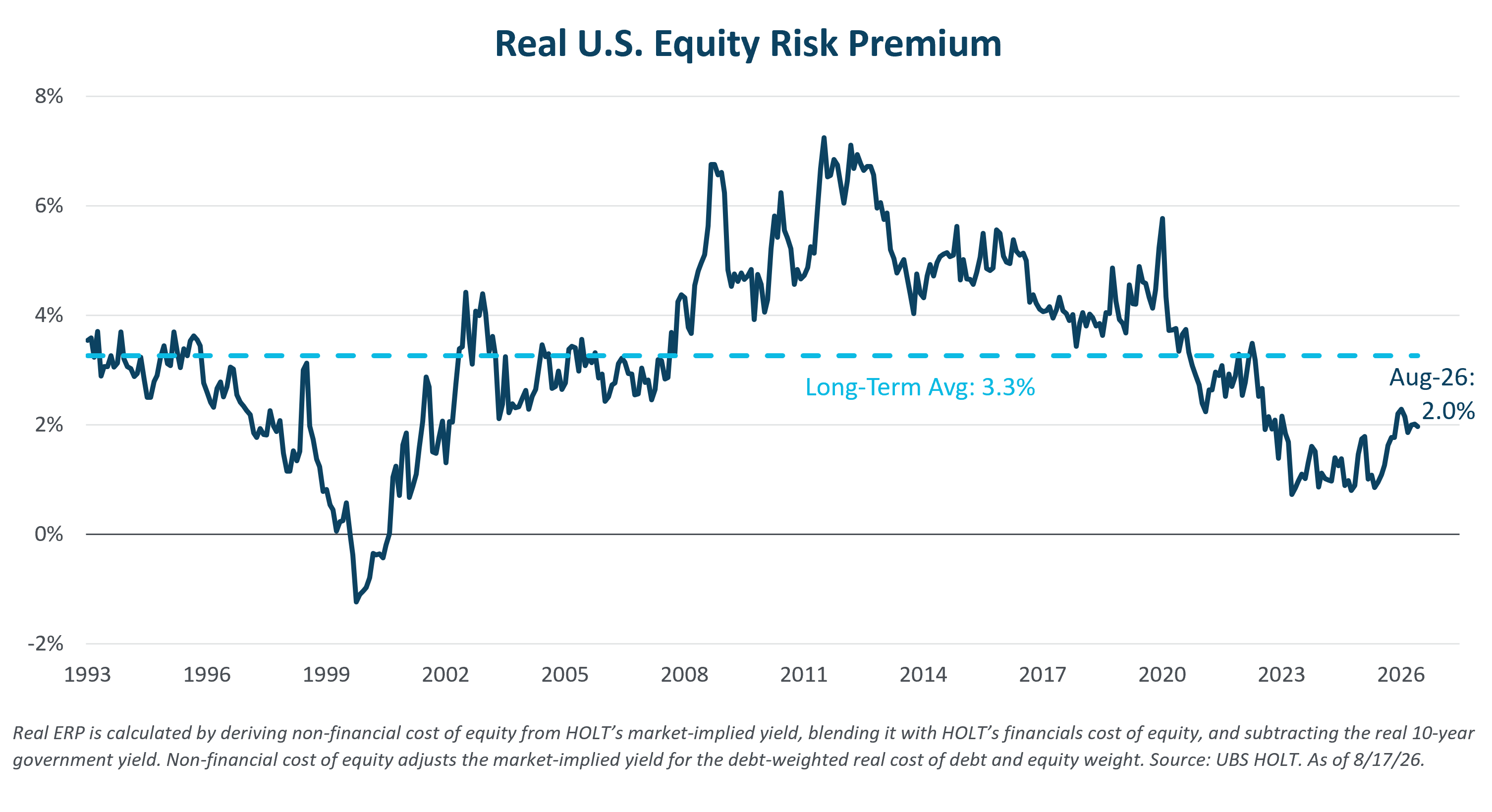
After several years near historically low levels, the real U.S. Equity Risk Premium (ERP) has begun to rise. At roughly 2.0%, it remains well below its long-term average of approximately 3.3%, but the upward trajectory is becoming more interesting. Inspired by this observation, we investigated what a rising ERP may actually tell us about future equity returns.
To that end, we examined more than three decades of history, comparing the real ERP with subsequent real S&P 500 returns across multiple investment horizons. The results suggest an important distinction: ERP has historically been much more useful as a long-term valuation tool than as a near-term timing signal.
What is the Equity Risk Premium?
At its core, the ERP measures the additional return investors require for bearing equity risk relative to a lower-risk government bond. A higher ERP implies greater prospective compensation for assuming equity risk; a lower ERP implies less.
We measure the Equity Risk Premium in real, inflation-adjusted terms. On the equity side, we use a market-implied discount rate that equates the present value of future corporate cash flows with current enterprise values. From that, we subtract a real 10-year government bond yield, and the difference between these measures gives us the real ERP - the prospective compensation for owning equities above the real lower risk alternative.
Why is the ERP rising now?
This question is particularly relevant today because the recent increase in ERP has occurred alongside strong equity markets.
The reason for this is because future cash flows have improved relative to current valuations. As expected future cash flows increase compared to the value investors are paying for them today, the implied discount rate required to reconcile those cash flows with current enterprise values also rises. Meanwhile, nominal government bond yields have also increased, but so have long-term inflation expectations. As a result, the increase in the real risk-free rate has not kept pace with the implied equity discount rate, allowing the Equity Risk Premium to widen.
That leaves the ERP (as of 8/17/26) at roughly 2.0% - still below the long-term average but improving from recent lows.
What Can The ERP Tell Us About Future Returns?
If the Equity Risk Premium represents prospective compensation for taking equity risk, the natural question is whether a higher starting ERP has actually translated into higher subsequent returns. The answer depends heavily on the investor's time horizon.
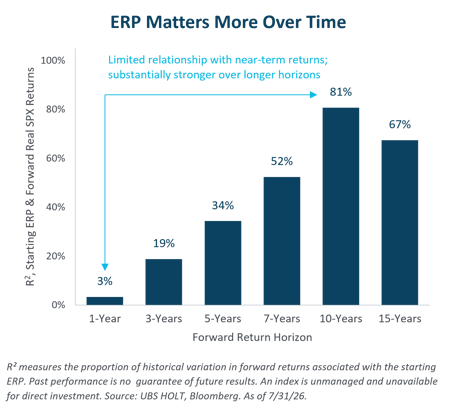
We compared the ERP observed at each starting date with the S&P 500's subsequent real total return over multiple different forward periods. Each bar in the adjacent chart represents the R-squared from a separate relationship between starting ERP and the forward S&P 500 return over that specific horizon.
At one year, the relationship is almost nonexistent. The starting ERP explains only about 3% of the historical variation in subsequent one-year real returns. At the 10-year horizon, R-squared reaches a peak of approximately 81%. Interestingly, the relationship weakens at 15 years rather than simply strengthening as the measurement horizon increases.
The implication is important. The starting ERP has told investors very little about what equities will do next year, but substantially more about the long-term return environment they are entering.
Higher Starting ERP, Higher Long-Term Returns
Next, we divided the historical ERP observations into quintiles, from the lowest starting ERP environments to the highest, and examined the distribution of subsequent annualized 10-year real S&P 500 returns.
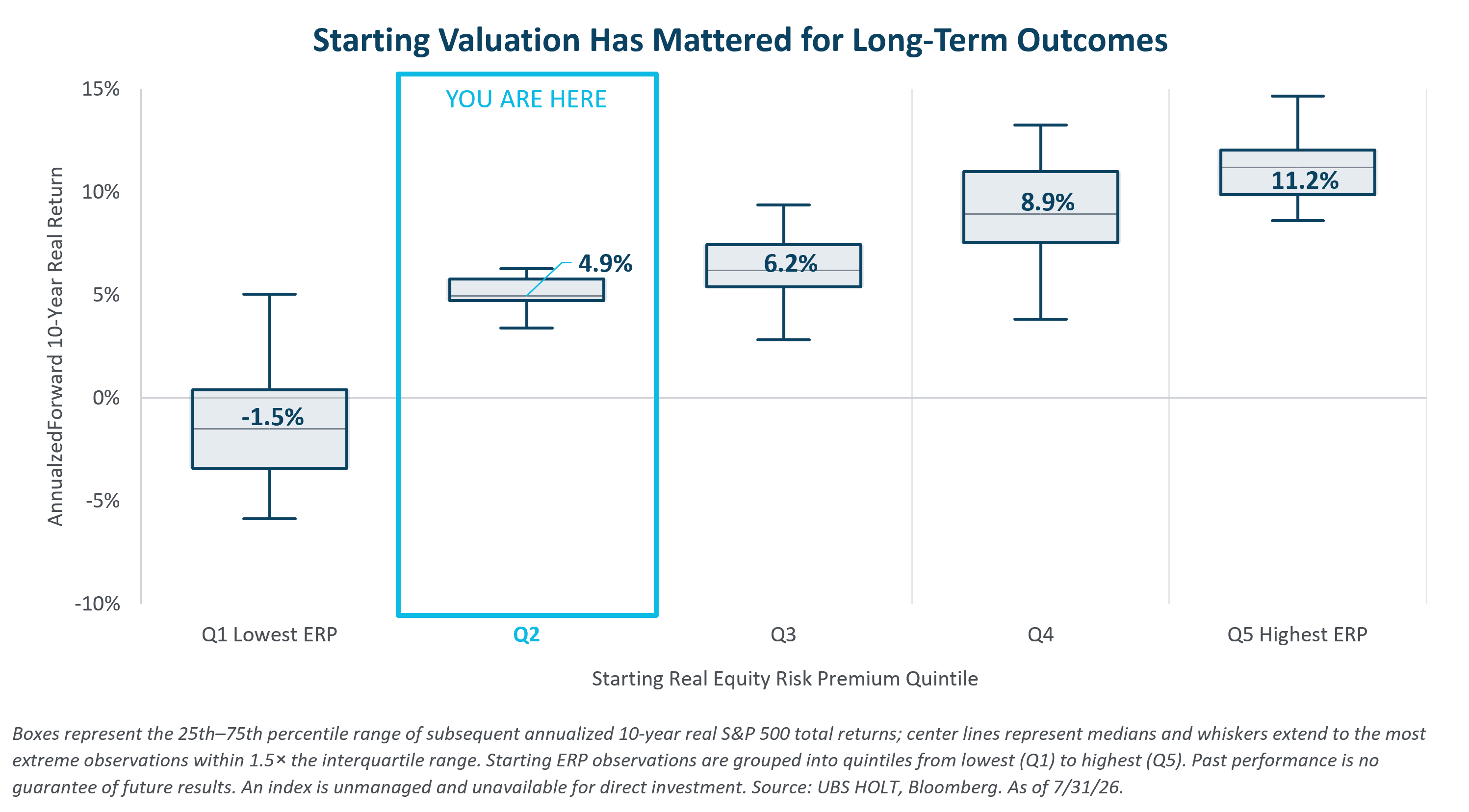
The progression is remarkably orderly. When the starting ERP fell within the lowest quintile, the median subsequent 10-year real return was -1.5% annualized. As the starting ERP increased across quintiles, so too did the median forward 10-year real returns.
Importantly, the relationship does not imply that the ERP causes future equity returns, nor should the analysis be interpreted as a precise 10-year market forecast. Instead, it reinforces a simpler conclusion: starting valuation has historically contained meaningful information about the long-term return environment.
Today, the real ERP falls within the second historical quintile - one that has generally been consistent with positive long-term real returns, but hardly an indication of "cheap" valuation.
Can the ERP Rise While Equities Are Strong?
Historically, changes in the ERP have tended to move inversely with recent equity performance. We think this is evidence that rapidly rising markets can compress prospective compensation for equity risk, while falling markets can expand it.
The latest setup, however, looks different as the ERP has risen alongside relatively strong trailing real S&P 500 returns. Plotting the year-over-year change in the real ERP against trailing one-year real equity returns places the current market in the relatively uncommon "Rising ERP / Strong Returns" quadrant. This combination has accounted for only ~14% of the historical observations in our sample, yet uncommon does not necessarily mean unfavorable.
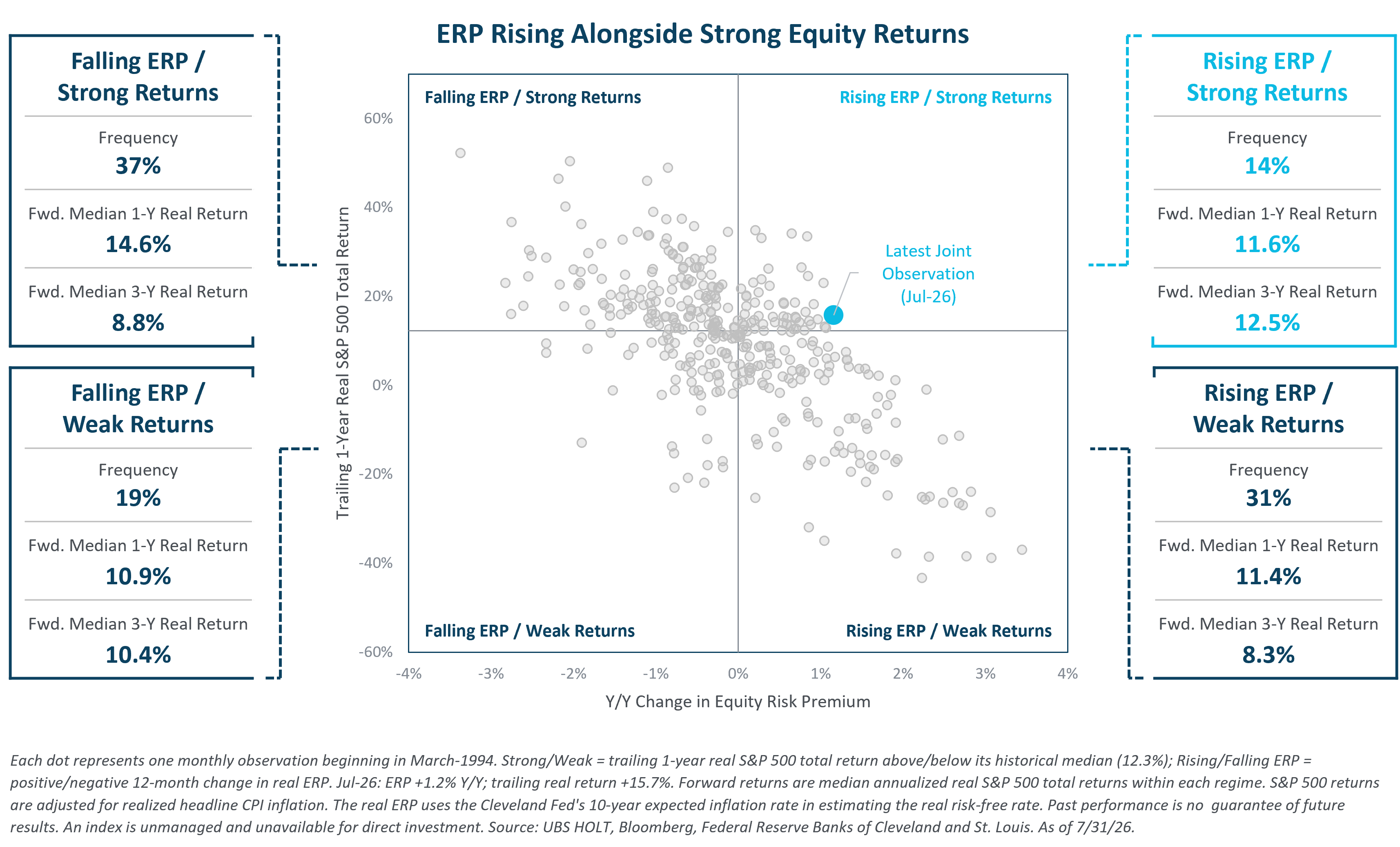
We examined what happened following previous periods with the same combination. Historically, Rising ERP / Strong Return environments were followed by median real S&P 500 returns of approximately 11.6% over the subsequent year and 12.5% annualized over the subsequent three years.
This event study is meant to address the question of whether a rising ERP alongside an already-strong equity market has been a warning signal to investors historically. The evidence suggests it has not.
That is consistent with the economics behind the recent ERP increase. If the ERP were rising solely because equity prices were collapsing, this combination would be difficult to reconcile. Instead, improving expected cash flows relative to valuations have helped raise the market-implied equity discount rate even as equity prices have remained strong.
Valuation, Not Timing
Historically, the real Equity Risk Premium has offered relatively little information explaining near-term market returns, but over longer periods - particularly around 10 years - the relationship between the starting ERP and subsequent real equity returns has been considerably stronger. For investors, we think that may be the most useful conclusion.
The ERP should not be used for market timing. Instead, we think it can offer investors valuable information about the long-term return environment they are entering.

.jpg?width=1000&height=1000&name=Swaim%20(website).jpg)
.jpg?width=1000&height=1000&name=Harvey%20(website).jpg)
.jpg?width=1000&height=1000&name=Steffanus%20(Website).jpg)
.jpg?width=1000&height=1000&name=M.%20Valentinas%20(website).jpg)
-min.jpg?width=394&height=394&name=Zessar%20(website)-min.jpg)
-1.jpeg?width=502&height=502&name=Florida%20(website)-1.jpeg)
.jpg?width=1000&height=1000&name=Lamb%20(website).jpg)
.jpg?width=1000&height=1000&name=Prassas%20(website).jpg)
.jpg?width=1000&height=1000&name=Crawshaw%20(website).jpg)
.jpg?width=1000&height=1000&name=Clarke%20(website).jpg)
.jpg?width=1000&height=1000&name=Cialdella%20(website).jpg)

.jpg?width=1000&height=1000&name=Harmon%20(website).jpg)
.jpg?width=1000&height=1000&name=Tracy%20(Website).jpg)