Upstream inflation pressures are re-emerging.
Recent data point to renewed inflation pressure coming from upstream sources. Global supply chain stress has turned higher, a factor that previously contributed to supply-driven inflation. At the same time, several key commodity indexes, including the CRB Raw Industrials Index, have accelerated to multi-year highs, suggesting rising input costs across a broad range of goods.
This matters because inflation typically responds to input cost pressures with a delay. When year-over-year raw industrial prices are pushed forward by some monthly interval (seven months was the most significant for the Raw Industrials Index), the relationship with inflation becomes more evident. The combination of rising commodity prices and supply-side pressure increases the likelihood that inflation remains a relevant macro risk into 2026.
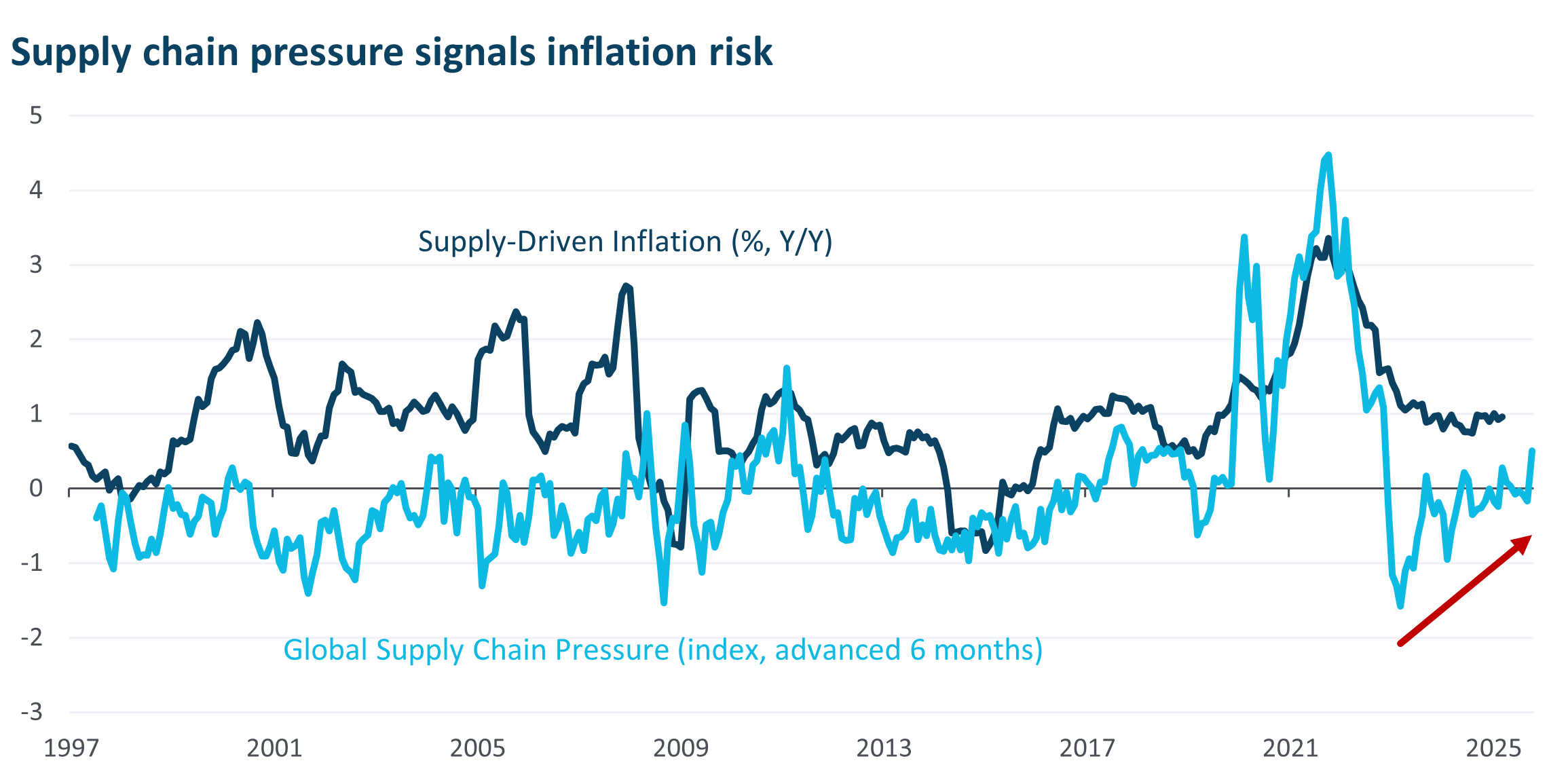
Sources: Federal Reserve Bank of San Francisco and New York, Simon White (Bloomberg). Global Supply Chain Pressure as of 12/31/25. Supply-Driven Inflation as of 11/30/25.
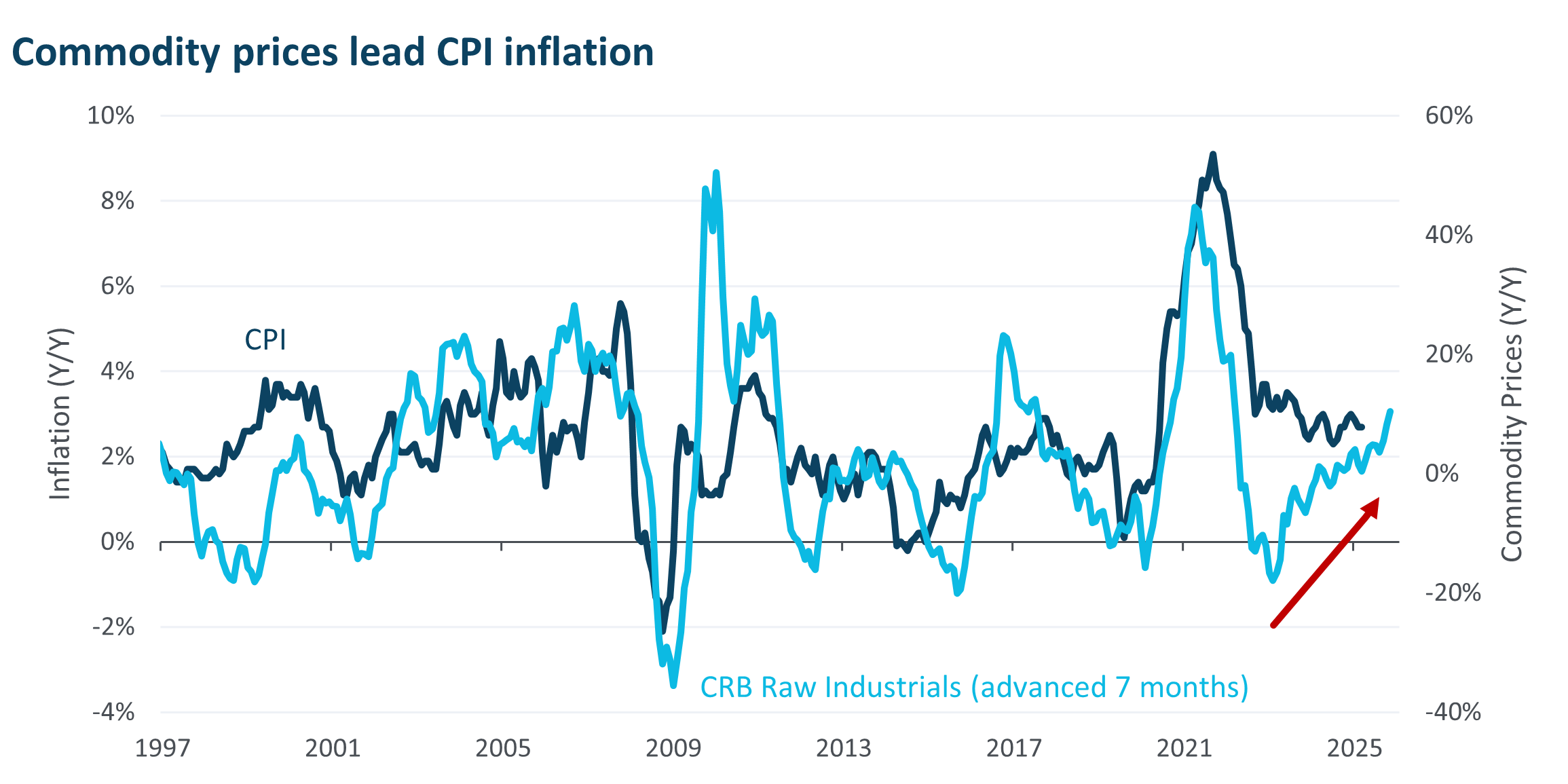
Sources: Bureau of Labor Statistics, Commodity Research Bureau, Bloomberg, Data as of 12/31/25.
Policy uncertainty amplifies market volatility.
Inflation risk is occurring alongside elevated economic and policy uncertainty, as proxied by the Baker, Bloom and Davis Economic Policy Uncertainty Index. Periods of heightened uncertainty tend to coincide with more frequent and larger spikes in the VIX index, as investors respond to shifting information and policy signals. Taken together, persistent uncertainty and renewed inflation pressure point to a higher baseline level of market volatility in 2026.
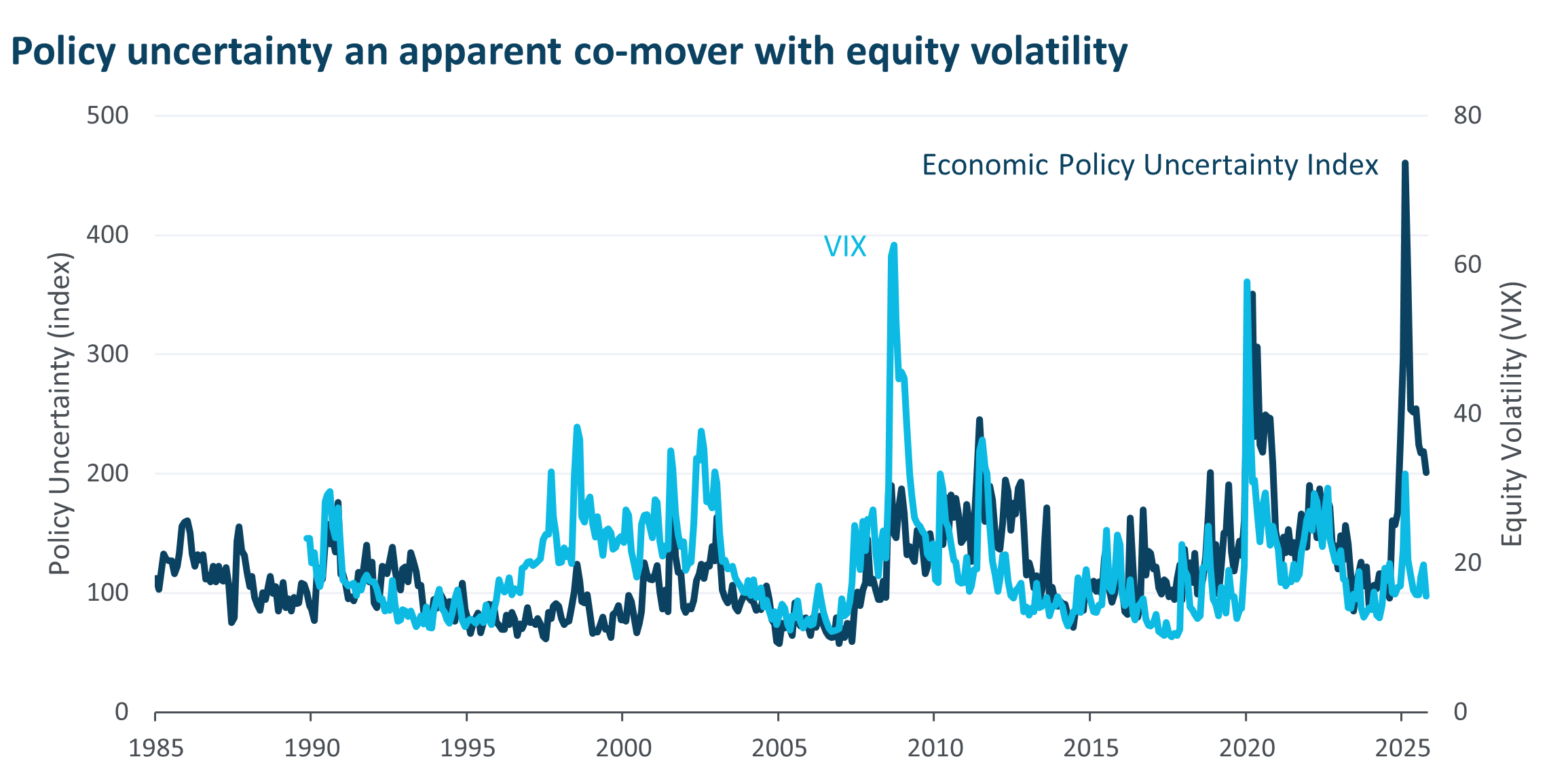
Sources: CBOE, Baker, Bloom and Davis, Bloomberg, Joe Little (HSBC). Data as of 12/31/25.
To view all '10 Surprises for 2026', click here
The '10 Surprises for 2026' are not intended as statements of fact. They are predictions that may or may not occur based on a variety of circumstances.
The Baker, Bloom and Davis composite index of economic policy uncertainty draws on the frequency of newspaper references to policy uncertainty and to other indicators of policy uncertainty including expiration of tax provisions and disagreement among economic forecasts of inflation and government expenditure.
Supply-drive inflation is composed of the contributions to personal consumption expenditures (PCE) inflation from supply-driven versus demand-driven components.
Global Supply Chain Pressure Index is normalized such that a zero indicates that the index is at its average value with positive values representing how many standard deviations the index is above this average value (and negative values representing the opposite).
The CRB Raw Industrials index is a subset of commodity prices tracking a dozen+ sensitive, early-stage raw materials that are not traded on futures exchanges.
Past performance does not guarantee future results. Investing in securities involves risk, including the possibility of the loss of principal.
Please see Advisory Research’s Form ADV Part 2A, which is available upon request, for more information.
Advisory Research is providing this material for informational purposes only. The information provided is not intended to recommend any company or investment described herein, and is not an offer or sale of any security or investment product or investment advice. Before making any investment decision, you should seek expert, professional advice and obtain information regarding the legal, fiscal, regulatory and foreign currency requirements for any investment according to the laws of your home country or place of residence.
Certain information contained herein constitutes forward looking statements, projections and statements of opinion (including statements of financial market trends). Such information can typically be identified by the use of terminology such as “may”, “will”, “should”, “expect”, “anticipate”, “project”, “estimate”, “intend”, “continue” or “believe” or comparable terminology. All projections, opinions and forward looking statements are based on information available to Advisory Research as of the date of this presentation, and Advisory Research’s current views and opinions, all of which are subject to change without notice. Due to various risks and uncertainties, actual events or results may differ materially from those reflected or contemplated in forward looking statements. Additionally, information and views presented herein may be drawn from third-party or public sources which are believed, but not guaranteed, to be reliable and which have not been verified for accuracy or completeness.
Advisory Research’s strategies are actively managed and not intended to replicate the performance of any cited index: the performance and volatility of Advisory Research’s investment strategies may differ materially from the performance and volatility of a cited index, and their holdings will differ significantly from the securities that comprise the index. You cannot invest directly in an index, which does not take into account trading commissions and costs.
Advisory Research is an investment adviser in Chicago, IL. Advisory Research is registered with the Securities and Exchange Commission (SEC). Registration of an investment adviser does not imply any specific level of skill or training and does not constitute an endorsement of the firm by the Commission. Advisory Research only transacts business in states in which it is properly registered or is excluded or exempted from registration. A copy of Advisory Research’s current written disclosure brochure filed with the SEC which discusses among other things, Advisory Research’s business practices, services and fees, is available through the SEC’s website at: www.adviserinfo.sec.gov

.jpg?width=1000&height=1000&name=Swaim%20(website).jpg)
.jpg?width=1000&height=1000&name=Harvey%20(website).jpg)
.jpg?width=1000&height=1000&name=Steffanus%20(Website).jpg)
.jpg?width=1000&height=1000&name=M.%20Valentinas%20(website).jpg)
-min.jpg?width=394&height=394&name=Zessar%20(website)-min.jpg)
-1.jpeg?width=502&height=502&name=Florida%20(website)-1.jpeg)
.jpg?width=1000&height=1000&name=Lamb%20(website).jpg)
.jpg?width=1000&height=1000&name=Prassas%20(website).jpg)
.jpg?width=1000&height=1000&name=Crawshaw%20(website).jpg)
.jpg?width=1000&height=1000&name=Clarke%20(website).jpg)
.jpg?width=1000&height=1000&name=Cialdella%20(website).jpg)

.jpg?width=1000&height=1000&name=Harmon%20(website).jpg)
.jpg?width=1000&height=1000&name=Tracy%20(Website).jpg)